


CyberKnife vs. Gamma Knife for Brain Tumors: Choosing the Best Non-Invasive Treatment in 2026

When faced with a brain tumor diagnosis, the prospect of traditional open surgery can be daunting. Fortunately, advancements in medical technology have made non-invasive “radiosurgery” the global standard for many cases.
Two of the most prominent technologies are CyberKnife and Gamma Knife. While both use targeted radiation to destroy tumor cells with sub-millimeter precision, they differ significantly in patient experience, flexibility, and application.
This guide explores the critical differences between these two life-saving technologies to help you and your family make an informed decision.
Understanding Stereotactic Radiosurgery (SRS)
Stereotactic Radiosurgery (SRS) is not actually “surgery” in the traditional sense. It involves no knives, no incisions, and no hospital stays. Instead, it uses highly focused beams of radiation to treat tumors in the brain and spine.
The goal of SRS is to deliver a high dose of radiation directly to the tumor while sparing the healthy surrounding brain tissue. This makes it an ideal option for inoperable tumors, recurrent cancers, or patients who cannot undergo general anesthesia.
CyberKnife: The Modern Robotic Revolution
The CyberKnife System is the world’s first and only robotic radiosurgery system. It uses a linear accelerator mounted on a highly flexible robotic arm to deliver radiation from thousands of different angles.
Key Features of CyberKnife:
-
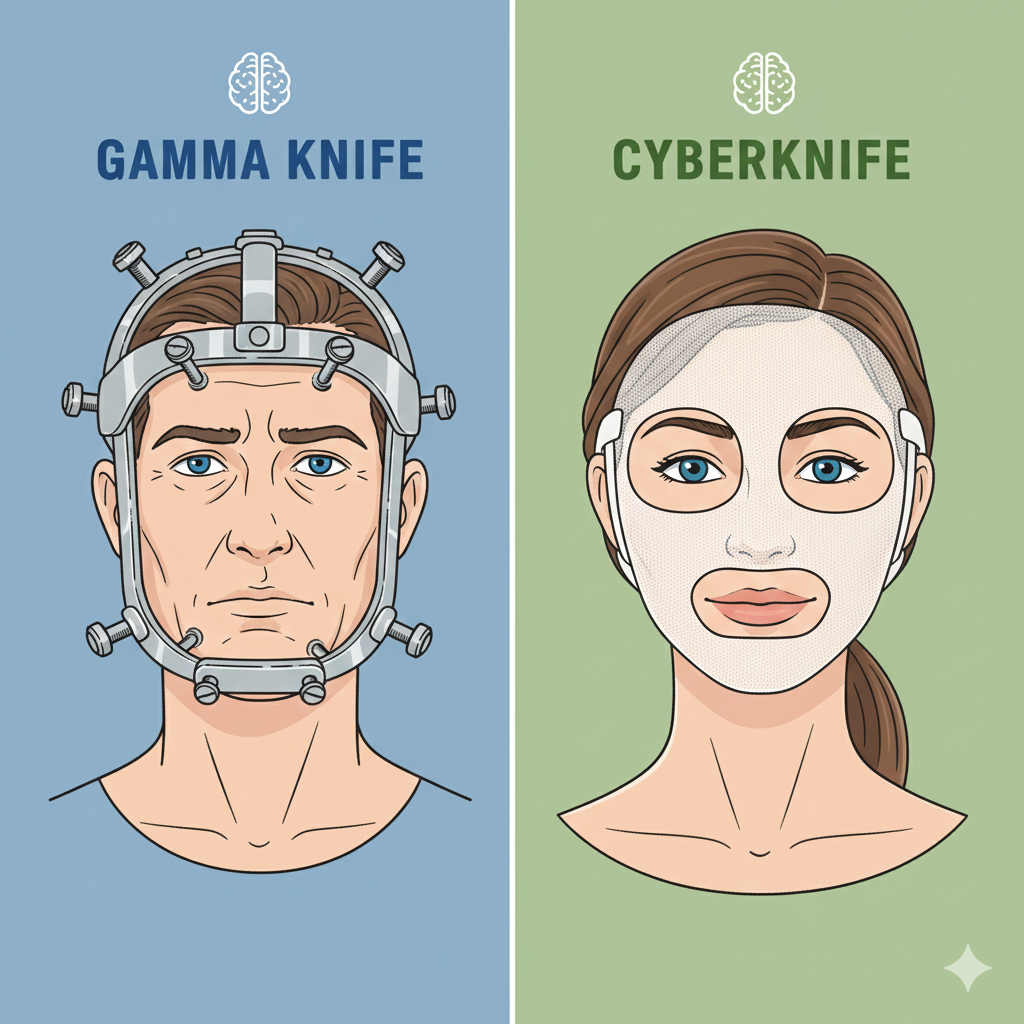
Frameless Comfort: Unlike older systems, CyberKnife does not require a metal frame to be bolted to the patient’s skull. Instead, it uses a comfortable, custom-made mesh mask.
-
Real-Time Tracking: It features advanced “6D” image-guidance technology that tracks the tumor’s position in real-time, automatically adjusting for even the slightest head movement.
-
Treatment Flexibility: CyberKnife can deliver the total radiation dose in a single session or spread it over 2 to 5 days (fractionated treatment). This flexibility is often safer for larger tumors or those near critical structures like the optic nerve.
Gamma Knife: The Conventional Precision Tool
Gamma Knife has been a “gold standard” for decades, particularly for very small, deep-seated brain lesions. It uses multiple fixed sources of Cobalt-60 to focus beams on a single point.
Key Considerations for Gamma Knife:
-
Invasive Head Frame: A significant drawback for many patients is the requirement of a metal head frame. This frame must be physically screwed into the patient’s skull under local anesthesia to ensure zero movement during treatment.
-
Single-Session Limit: Because the head frame is invasive, the entire process—imaging, planning, and radiation—must usually be completed in one grueling day.
-
Limited Scope: Gamma Knife is almost exclusively designed for the brain and the very top of the cervical spine.
CyberKnife vs. Gamma Knife: A Head-to-Head Comparison

The following table summarizes the primary differences between these two leading technologies:
| Feature | CyberKnife | Gamma Knife |
| Invasiveness | Non-invasive (Soft mesh mask) | Invasive (Metal head frame bolted to skull) |
| Precision | Sub-millimeter with real-time tracking | Sub-millimeter with physical immobilization |
| Anesthesia | None required | Local anesthesia for frame placement |
| Treatment Area | Brain, Spine, and Full Body | Brain and Upper Cervical Spine only |
| Sessions | 1 to 5 sessions (Flexible) | Typically 1 single session |
| Recovery | Immediate return to daily activities | Short recovery from frame pin sites |
Why International Patients Choose India for CyberKnife
As we move through 2026, India has solidified its position as a global hub for advanced neurosurgery. Patients from the USA, UK, UAE, and across Africa are increasingly seeking care from the best neurosurgeon in India due to the combination of world-class technology and cost-effectiveness.
Leading experts like Dr. Aditya Gupta have pioneered the use of CyberKnife in the region. With over 32 years of experience and training from elite institutions like AIIMS and Wake Forest University (USA), Dr. Gupta is recognized as a top neurosurgeon in India for complex brain tumor management.
For international patients, choosing a specialist who is also the best neurosurgeon for DBS and brain hemorrhage ensures a comprehensive approach to neurological health.
Clinical Outcomes and Success Rates
Recent data from 2025 and 2026 show that CyberKnife matches or exceeds Gamma Knife in clinical efficacy for most brain metastases and acoustic neuromas. Because CyberKnife allows for “fractionation” (breaking the dose into smaller parts), it significantly reduces the risk of radiation-induced swelling or “radionecrosis” in healthy brain tissue.
Conditions Treated Successfully with CyberKnife:
-
Malignant Brain Tumors (Gliomas, Metastases)
-
Benign Tumors (Meningiomas, Acoustic Neuromas)
-
Trigeminal Neuralgia (Chronic facial pain)
-
Arteriovenous Malformations (AVMs)
Expert Insight from Dr. Aditya Gupta
Choosing between these technologies depends on the tumor’s size, location, and the patient’s overall health. However, the move toward “patient-centric” care in 2026 favors the non-invasive, robotic approach of CyberKnife.
As the best neurosurgeon for brain hemorrhage and tumor surgery, Dr. Gupta emphasizes that the goal is not just survival, but maintaining a high quality of life. The ability to undergo treatment without a painful head frame and return home the same day is a revolutionary step in neuro-oncology.
Conclusion: Your Path to Recovery
Deciding on brain tumor treatment is a life-altering choice. While Gamma Knife remains a reliable option for specific small lesions, CyberKnife offers a superior level of comfort, flexibility, and the ability to treat tumors that move or are located near sensitive nerves.
If you are looking for the best neurosurgeon in India to discuss your options, expert care is available. Advanced facilities and world-renowned surgeons make India a premier destination for those seeking the highest standard of neurosurgical intervention.
Take the Next Step Toward Healing
Don’t navigate this journey alone. Consult with a global leader in neurosurgery to find the treatment plan right for you.
- Tags:
- acoustic neuroma surgery
- advanced neurosurgery technology
- affordable brain surgery India
- best hospital for neurosurgery
- best neurosurgeon for brain hemorrhage
- best neurosurgeon for DBS
- best neurosurgeon in India
- brain cancer specialist India
- brain metastases treatment
- brain tumor survival rates
- brain tumor treatment
- CyberKnife cost India
- CyberKnife India
- CyberKnife vs Gamma Knife
- Dr. Aditya Gupta neurosurgeon
- frameless radiosurgery
- Gamma Knife disadvantages.
- Gamma Knife vs CyberKnife
- medical tourism India brain surgery
- meningioma treatment
- neurosurgeon for international patients
- neurosurgery India 2026
- non-invasive brain surgery.
- non-surgical brain tumor removal
- radiation therapy for brain
- robotic radiosurgery
- SRS surgery
- Top neurosurgeon in India
- trigeminal neuralgia relief
